

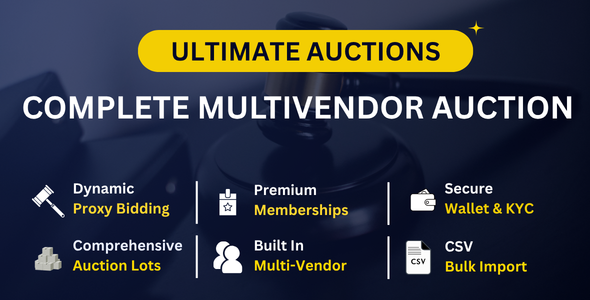
The WooCommerce Auction Marketplace plugin offers a robust framework for integrating auction functionality directly into your existing WooCommerce store, enabling a comprehensive Multivendor Auction platform. This tool is designed for store owners looking to expand their e-commerce offerings to include various bidding models, catering to a diverse audience of buyers and sellers. It’s particularly useful for businesses aiming to host dynamic sales events, build a community around unique item exchanges, or empower multiple vendors to sell through auctions on a single storefront.
Implementing this solution means transforming a standard product catalog into an interactive bidding environment. Customers can engage with products in a new way, placing bids and tracking items of interest. Store administrators gain granular control over auction types, durations, and vendor participation, ensuring the platform aligns with their specific business model, whether for individual store-run auctions or a bustling marketplace for multiple sellers.
The WooCommerce Auction Marketplace – Multivendor Auction solution introduces several distinct bidding methods directly onto product pages. For a standard auction, a product page displays the current highest bid, the number of bids placed, and a countdown timer indicating when the auction concludes. Users enter their bid amount into a designated field and click a "Place Bid" button. If their bid is successful, the page updates immediately to reflect the new highest bid, often highlighting their new leading position.
Reverse auctions operate differently; here, sellers compete to offer the lowest price. On the product page, instead of bidding higher, vendors submit progressively lower offers. The lowest unique bid wins. Sealed bid auctions maintain bid secrecy until the auction ends. Participants enter their offers into a private field, and these bids remain hidden from other users. Once the auction concludes, the highest bid is revealed, and the winning bidder is notified. This approach encourages strategic bidding without real-time pressure.
The platform also supports automatic bidding, where a user sets a maximum bid, and the system incrementally bids on their behalf up to that limit to maintain their leading position. On the product detail page, this functionality is presented as an option where users can specify their proxy bid amount. The system then manages the bidding process for them, only increasing the bid when necessary to outrank another participant, ensuring they don’t overpay while staying competitive.
As a WooCommerce Auction Marketplace extension, this solution is built to integrate seamlessly with the core WooCommerce framework. It leverages WooCommerce’s product types, order processing, and user management systems, ensuring a consistent experience for both administrators and customers. Compatibility extends to various WooCommerce payment gateways, allowing for flexible transaction handling for auction winnings. Most well-coded WordPress themes that adhere to WooCommerce standards will display auction products correctly, with specific templates often provided for optimal presentation of bidding elements and timers. The architecture also allows for robust interaction with other extensions, such as shipping calculators and notification systems, enhancing the overall marketplace functionality.
The flexibility of the Multivendor Auction functionality opens doors for diverse business models. Consider an antique dealer specializing in rare collectibles; they could host weekly live auctions for unique items, drawing in enthusiasts who appreciate the real-time bidding experience. Art galleries might use sealed bid auctions for high-value pieces, allowing serious collectors to place private offers. For electronics retailers, a reverse auction could be an effective way to offload excess inventory by letting vendors compete for the lowest wholesale price on bulk orders.
Beyond traditional retail, this system could power niche marketplaces. A platform for pre-owned luxury goods could enable individual sellers to auction their items, with the platform facilitating the bidding and transaction. Local community groups might create an auction site for fundraising events, allowing members to contribute items and bid on others. The adaptable nature of the auction types means it can serve many different scenarios where competitive pricing or unique item acquisition is desired.
Establishing an auction-driven e-commerce platform requires specific tools that go beyond standard product listings. The WooCommerce Auction Marketplace – Multivendor Auction solution provides the necessary feature set to transform a basic store into a dynamic bidding environment. Its robust architecture and diverse auction types offer a solid foundation for engaging customers and empowering vendors. The ability to inspect, modify, and adapt the underlying code base provides site owners with ultimate control over their platform’s evolution, ensuring it can be tailored to meet unique business requirements and remain resilient against future changes without vendor lock-in. This approach offers significant long-term value, enabling businesses to continuously refine their auction processes and user experience.
There are no reviews yet.
From multipurpose themes to niche templates